Saturday, January 19, 2013

Right to Marriage?

by Christine
Today I received a personal message on Facebook from a long time friend from France.
This friend has 4 grown children, but he has never married and has lived his whole adult life in cohabitation. He's always been on the far left side, ecologist, rebellious to any faith, religion, law, etc.. A pure product from 1968 who stayed stuck there.
His message was a "comic" showing 2 men hand in hand saying:
"It is sad that nowadays people demonstrate not to gain rights but to make sure other people do not get rights."
It made me really sad... but after all, what does he know about marriage?
He has always seen marriage as an alienating institution, an absurd and outdated heritage from a traditionalist society. Our French president, by the way, must think the same with 5 children from 2 different women he never married, and living now with a not-yet-divorced woman! Isn't it paradoxical to hear them support "gay marriage?" Why would someone who has always rejected marriage defend and support "gay marriage?" "Gay marriage" is NOT marriage, it just mimics marriage. And we know well that anything that mimics something good has evil roots.
We are often accused of 'intolerance.' Yet those who prone "tolerance" are the ones who rudely and aggressively throw garbage at us for speaking the truth. Marriage cannot be reduced to a mere legal right.

Tous pour le Mariage Facebook profile picture
The same day, we also received a short video of a drunkard at the French demonstration who was yelling: "A father, a mother, it's not complicated! IT'S NATURAL! Everybody wants a father and a mother! I want a father and a mother! I'm not going to go home and say Hi dad! Hi dad! Everybody wants a home with a dad AND a mom!..." In his drunkenness he was much wiser than our ecologist friend who should at least understand the "natural" aspect of the whole thing.

Still the same day, I received another short note, from a French psychoanalyst friend this time:
"The probable unconscious fantasy of homosexuals is a fantasy of omnipotence. To get married you need two different people. Or getting married with the same is like getting married with oneself. It says I refuse to be in need of another..."

The question of equal rights is for the "feel good-do good" and it causes much damage. As I said above, marriage is not a question of rights, and deep in our hearts, we all know it.
So what is behind all this? As Gilles Bernheim says: the goal is to undermine the foundations of the individual and the family.
I guess our civilization is on the verge of disappearing.  It's not rocket-science, just look back at the Greeks and the Romans... "When anthropologist J. D. Unwin studied the origins and development of eighty civilizations, he discovered a profound connection between the vitality of a society and the strength of its marriages and families. He concluded that any society that did not direct its sexual energies toward the good of marriage and family would not last." (Jason Evert-2004- citing Donald DeMarco, 1999)
Notre-Dame Cathedral, Paris
For those of you who speak French, here is the complete essay from Gilles Bernheim, Chief Rabbi of France.

Sunday, January 13, 2013

Go France!

-->
By Christine

ONE MILLION gathered in Paris today to protest against gay marriage!
I hadn’t been proud of my home country in a long time! Today I truly am!


Not long ago, one of my Goddaughters asked me on Facebook: “tell, me, my dear God Mother, what are your reasons against gay marriage?”
I answered, warning her that it couldn’t be a short answer…
Now I know better! It can be a short answer (at least at first)! And it doesn’t even have to be a “religious” answer (again, at first).
As Rabi Gilles Bernheim says, “it is not because people love each other that they systematically have the right to get married! For example, a man cannot marry an already married woman, even if they love each other. A woman cannot marry two men under the motives that she loves both and both want to be her husband. Or a father cannot marry his daughter even if their love is only paternal and filial! Even in the name of equality, tolerance, the fight against discrimination, and other principles, we cannot give the right to marriage to all those who love each other.”

Marriage is not only the public recognition of two people who love each other, or “the public recognition of a committed relationship between a man and a woman (or two adults) for their fulfillment.” says William May
As the USCCB declared on December 6th, 2012, marriage is, “the universal institution that unites a man and a woman with each other and with the children born from their union.” (Emphasis added).


Gay marriage wouldn’t take into account the fundamental right of children to have a mother AND a father, to know their roots, where they come from; in short, it would deliberately deny children their right to their identity, and, from that, to their psychological equilibrium. It doesn’t mean that a homosexual couple cannot be loving, or that they aren't capable of raising children. But they cannot give what they do not have. And what they do not have is essential to the good development of any child. Love is not enough. Love doesn’t give all of the basic psychological structures any child needs to know his/her genealogy in order to position himself/herself as an individual.

From the beginning of humanity and until the end of time, we are born male or female, in a chain of generations, and no one can ever change this!

Go France!

Saturday, January 5, 2013

Happy New Year!

By Mattie

Hello,

It's been quiet around here, hasn't it?!
Well we are enjoying this season as much as we can between bouts of stomach flu with all that it has to offer! But mainly peace and quiet at home, near the roaring stove....
So instead of my monthly liturgical post, I will keep it sweet and short.

Our families have two traditions to begin the New Year right. First, we write a letter to the Blessed Mother, second, we are chosen by a saint who will travel with us throughout the year.

Letter to the Blessed Mother

Every year on New Year's Day, after going to Mass (it IS a Holy Day of obligation, you know), we write a letter to Mary. What kind of letter? Any kind you want! Mainly it is a letter to thank her for the blessings of the previous year, and to entrust our dreams, needs and desires for the coming year. Write it just as you would write to your mother, entrusting everything to her.
So that's the ideal version, but you really have all of January to do it ;) Even though I was quite late in bringing you this tradition, you can still do it!

Then what do you do with the letter? We place ours underneath our statue of Mary and re-open it on the next New Year's Eve. When you open it again, you will be amazed by how much Mary will have blessed you!


The Year with a Saint

So what do I mean by being chosen by a saint? No, I promise I haven't enjoyed too much eggnog!

Every New Year's Eve, after a small family prayer to bring the year to a close, we pass around a basket. One by one, each of us picks out a slip of paper. On that piece of paper is a quote from a saint. It is a quote to live up to for a year, and a saint to discover and befriend, to help you walk closer to God and grow in holiness.
Oh, and a head's up! The quote will usually be dead on! Dead on something you know you need to work on!

Here it is: printable saints quotes PDF
The best is to print it on sheets of business cards.

all the saints by Fra Angelico
Another source to discover a new saint is this very fun website: Saint's Name Generator
And again, yes, you have all of January! We actually keep the basket with the extra quotes for any guests that come visit in January.

Well happy New Year again! Enjoy it and make it holy!

Sunday, December 23, 2012

Merry Christmas!


The CatholicMarriagePrep.com team wishes you a very merry and bright Christmas!
May the light of Christ shine in your lives throughout the New Year!

Christine and Christian, Moses and Mattie, Karen and Deano, 
Gordon and Mary, Sarah and Ryan, Amber and Greg, 
Carmen y Rudy, Maura and Pete, Dan and Maria, 
Ryan and Mary Rose, Jehanne et Olivier
 
 (we'll be back for the New Year!)

Thursday, December 13, 2012

About Spanking

Today we received this question from a couple:
"I have a follow up question about spanking. Th
e extra reading was against spanking and made the argument based on spiritual beliefs.
I was raised Catholic as was my mom, cousins, and uncles. We were all spanked.
What is your stance on spanking and can you share some personal experiences with us (of you as a child and as a parent)?
One last thing. If its "wrong" to spank according to the church, why did nuns in school slap kids on the hands with rulers?
Thanks for the extra input!"
Johnny

Gabriel, one of our grandsons
Hello Johnny!
A very good question indeed! Here is what I would say about spanking: I believe it should be avoided at all costs!
It can happen, of course, as an accident, because we are only human! But violence in any form is never a good way to raise kids, or to solve problems. Often, it appears more like a confession that we are not able to handle the situation. It is NOT a parenting method.
If it does happen, as it's bound to, when things cool down, we should always go back to the child and apologize, explaining that we lost our temper, that it is never right to hurt someone, that we are sorry, etc...
As a parent, I did happen to spank my daughters. I always felt miserable afterwards, and apologized each time.

Some people argue that you should spank calmly and never when you are angry. I have NEVER seen this happen. I believe it's what people would like to have happen, but sadly it doesn't work that way.

Spanking can be received by the child as the following message: it is OK to hurt someone when they upset you. Spanking can also push the child to lying and hiding his misbehavior, or blaming others.


A famous and popular French story about spanking
I remember from my childhood that any spanking I received didn't do me any good. It just triggered in me a lot of anger and rebellion. It made me fear my father. I resented him very much, it pushed us apart (and I cannot say that he spanked me a lot!). I never went to him to confide anything, but I would go to my mother, who didn't spank. Spanking never increases love, trust, or respect. On the contrary!

I have a friend who even had nightmares about her father because of the spanking! My friend was so afraid of her father that even later in life, when she was 19 and became pregnant out of wedlock, she didn't have the guts to tell him, and had an abortion (I'm not saying that she didn't have her share of responsibility in this of course).

So yes, spanking can have very serious consequences and I would never recommend it! It usually shuts down an opportunity for dialog. It is not a constructive way of handling a situation.


Samuel, one of our grandsons
As for the nuns slapping children's hands, I have never agreed with that method, and firmly believe that what they did was very wrong. Just because they were nuns, doesn't make what they did right. In those days, many people took the verse "Spare the rod, spoil the child," literally. It was a trend, and was misinterpreted as you saw in the document

"The Old Testament does have two references to corporal punishment, which are the mainstay of its proponents' biblical defense. These are Proverbs 23:13 and Sirach 30:1-3. (In some translations, such as the N.A.B., the Sirach verse refers to discipline and education.) Yet, even Proverbs, taken by itself, is questionable, particularly when viewed as the rationale for a parent's disciplinary foundation."


"I say these references are questionable because contextual interpreters of the bible (Catholic scholars - as opposed to literal interpreters) wonder if "rod" is not used metaphorically, as in a shepherd's rod. A shepherd would never beat his sheep - they are too precious and delicate. Also, could a "rod of violence" be used to bring comfort, as in "Thy rod and Thy staff they comfort me." God's truths do not contradict each other. A shepherd uses his rod to gently guide his flock - not to strike them. (A note on sheep husbandry: it is known that the fright of sudden noise alone can induce in sheep a shock which suppresses fertility. A sheep's guardian, whose job it is to protect the economic value of his herd, is aware of the sensitivity of his flock's constitution.)"

"Rod" may also be understood as a unit of measure that figuratively refers to the Torah (like our term "scales of justice"). In other words, we can interpret the proverb: "Spare your child the 'rod' (the Torah), and they won't 'measure up.'" Gregory K. Popcak, MSW, LCSW www.exceptionalmarriages.com

Now I know advocates of spanking whose children have grown into great adults, too. It is just that for me, it is not a parenting method, just an accident that should be avoided.

I hope this answered all of your questions! Thank you for your interest in this issue! It is a very important one!

Christine

Sunday, December 2, 2012

December: Advent

By Mattie
December!
Prayerful or just too full? It's a crazy time of year, isn’t it? And the reason, well, let’s be honest, is not always the right one. The reason should be the Christ child, we all know it, but do not always follow it.

This year I challenge you to make it extra Christ centered and less crazy.
Here is what I am doing to tame the December monster and let in the little child:

- Very few commitments (bare bone minimum of invitations accepted, and if anyone is offended, they won’t remember by next year, anyway :))

- We don’t have any office parties, so that’s easy!

- School is closing for the whole of Advent until after the Epiphany.

- Lots of Christmas books are coming up from the basement (and I mean LOTS! I am a bookoholic and Christmas books are just so beautiful!)

- Advent wreath on the table starting on the first Sunday of Advent, with home made candles (find some beeswax sheets in purple and pink and you can roll your own candles, wonderful fun, good smell, and great tradition!)

- Advent calendar is slowly being filled for the kiddos with their Playmobil Nativity. (by the way, an Advent calendar should start on the first Sunday of Advent and go until Christmas day. It does not start on December 1st.)

- Lots of crafting and elfing around here, this year we are aiming for a mainly hand made Christmas! Lots of fun!

Our Nativity 2011

But most importantly we want to carve out time for prayer: Advent story, Jesse Tree, praying around the wreath, etc, and it is a time to GIVE! Not presents, not material things but MYSELF. It is often the hardest, at least for me. To give time to the 4 year old who wants to learn to knit (Who came up with that brilliant idea anyway?!) to give to the 6 year old who wants a story, to the 9 year old who just wants to be on Pinterest (PLEEEEAAAZZZE!) to the 8 year old who just needs a hug, and to the baby who just needs to be held, for an hour or so. Last but not least, of course, time to my husband, because he needs attention too :) So that summarizes Advent for me for this year!

Let's look in some of the beautiful Advent traditions from our Church.

The Jesse Tree:
Beginning with Creation, we walk through Salvation's history to understand better why Jesus came and how it all happened.

Our Jesse Tree in 2008
It is a long standing tradition. There have been Jesse Trees carved in churches since the Middle Ages. It traces the family of Jesus (a familiar trail on this blog! We love family history!) A beautiful family tree, and history to re-discover every year.

Here is the book we use, but you could also just go through the Bible.

The Advent Wreath:

Traditionally made of evergreen, but for us city dwellers, Target will have to do. As long as it is in a circle and has some leaves I say it's good enough. You will need 3 to 6 purple candles and one pink (or rose) candle. You light a new one every Sunday of Advent (the pink one is the third Sunday). We light our candles every night for dinner.

The Advent Calendar:

Advent Calendar 2009
On this one you can let your imagination run wild! There is, of course, the chocolates and goodies, but we try to keep it Christ centered by finding every day a new figure for our Nativity (the kids one, not MY nice one! I'm working on sharing.) This year we are going with a St. Francis theme: Playmobil nativity set and all the Playmobil animals I could find from bear and wolf, to peacock and frogs!

Now for some feast days!

December 3rd: St. Francis Xavier

December 6th: St. Nicholas

St. Nick's Day 2010
Our kids usually find their shoes filled with their first clementines of the season, pistachios, gold coins and Christmas books (perfect excuse for this bookoholic!) and of course cookies and gingerbread. (Remember my Alsatian roots? That's where it all comes from!)

December 8th: The Immaculate Conception: Holy Day of Obligation. Patronal Feastday of the United States of America! Usually pretty low key, with Mass and a nice dessert.

December 11th: our Lady of Guadalupe: Mexican dinner!

December 13th: St. Lucy

Lucie's Saint Lucia
That day we celebrate the saint of light and out own little light! 

Lucie, 2010
We pull out all the candles and start spreading them through the house, to wait for Christmas.

Then you have Las Posadas that start on December 16th: the re-enactement of Mary and Joseph looking for shelter. A beautiful Mexican tradition that goes on for 9 days.

Our O Antiphons ornaments under our Nativity on Christmas Eve spelling out Ero Cras (Tomorrow I will be here)
The O Antiphons start on the 18th and take us through the last week of Advent using the verses of O Come Emmanuel.

I could go on for years to come, but it's breakfast time and I'm hungry! See y'all in January!


Wednesday, November 28, 2012

Shaped by the Past - Part IV

By Christine
My family sure didn’t have as adventurous life as Christian’s!
My father’s grandfather’s name was François, and he was born in 1865 in Gilly sur Loire, from a family of farmers. Francois came to Le Creusot, the nearby booming industrial town, in search of a better life. He was hired at the great forge in 1881, and then transferred to the artillery workshop, producing weapons for the government. He worked there until his death in 1919.

Forge, Le Creusot
My father’s father, Joseph, was born in Le Creusot on November 8th, 1902. His mother, Elisa, was an orphan. She died from liver cancer on October 18th, 1914, when Joseph was only twelve. Her terrible sufferings marked him profoundly for ever. He had only one brother, Francis, who was 10 years older than him. Two other children, born in the middle, had died at an early age. So Joseph grew up with his father Francois. His personality wasn’t the happiest one. He thought that a woman’s job was to stay home and that she shouldn’t even read because it was time stolen from the care of the household. He became a metalworker and supervisor at Le Creusot's Schneider’s factory. 

Joseph at the factory
He wasn’t rich, and I remember that my grandparents didn’t have a bathroom in their second floor apartment. You had to go to the outhouse in the garden. Speaking of gardens, he was a very good gardener, and had lots of vegetables, fruit, and flowers. Dahlias were his specialty.
He never had a car, but when he retired, Joseph got a moppet and he would come visit us on it!
He loved fencing and was an incredibly talented handyman. He even built a radio from scratch. I also remember an incredible hair comb he had made from steel, and a beautiful engraved pie serving knife with a horn handle (I still have it). He also loved fishing and was skilled at painting.
I have at least two good memories of my grandfather. For Christmas, he would offer each of the five of us a 5 francs coin that he had polished and made all shiny. He was also excellent at making black currant liquor, from his own bushes of black currant. The treat was that we were always allowed to taste a small glass, even though it was so strong! I loved how it would run warm down your throat!
He had married Lucie on January 20th, 1925. 

Joseph and Lucie on their wedding day
Lucie had lost her mother too, when she was about 4 years old. Her family was from the north of France, just like General De Gaulle’s mother, who bore the same last name as her. This led me to write to General de Gaulle when I was 9 to tell him that we were from the same family! He answered me and I still have his handwritten note!


Lucie was the baby of eight children. They had moved to  Blanzy, not far from Le Creusot, on a small farm. Her older sisters had very whimsical ways of taking care of her. To calm her when their mother was working in the fields, they would put wine in her bottle! 

Lucie in the center
Very young, she became a housekeeper for a doctor’s family who taught her “good manners.” Then she helped her older sister with her small grocery store. Her sister thought it was time to get her married and arranged her meeting with Joseph. She was a good natured and cheerful person who absolutely loved children. Joseph and Lucie had only two sons, my father, Georges, and Henri. Lucie adored her sons and probably spoiled them a lot, doing everything for them. It was a real heartbreak for her when they got married. When her sisters visited unexpectedly (no phone!), it was always a feast of laughing and fun! She used to quilt heavy blankets to help bring some more money to the household. 

Joseph and Lucie with their two boys
She was the spiritual soul of the family and took her children to church while my grandfather practiced only for great feast days and Bishop’s visits. She would also ride her bicycle everywhere. During the war, she would ride her bike across the line of demarcation to get food to my uncle, Henri, who was at the seminary in free France 40 kilometers away.  She was even searched by the Nazis once. She died at 56. I was not yet 2 when she died, so sadly, I do not remember her.
 

Me in my Grand Mother's arms
Later on my grandfather remarried a woman from Southwestern France, Simone. We all loved her with her singing accent! But Le Creusot was not a cheerful town for her light spirit and she was never happy there.
Even though Joseph had not been a Churchgoer during his youth, he ended his life as a very practicing Catholic and his death in 1971 was a beautiful testimony of faith.

Friday, November 16, 2012

Shaped by the Past, Part III

By Christian
It’s during the liberation of Alsace, in the winter of 1945, that my Dad met my Mom in a little day dancing/coffee/pub that’s still in business to this day. I don’t believe World War II happened so that my parents could meet, but really, what were the odds that these two should meet? The Lord works in mysterious ways!

The place where my parents met
After he met my Mom, my Dad still had to go to Germany with the French led Moroccan troops before he could come back for her, in that beautiful little village of Eguisheim, cradle of Pope St Leon IX (11th century). 

Pope St. Leon IX's birth place
My Mom’s whole family lived in the big village farm. It was built in 1684 by the Ginglinger family. 

My cousin, Pierre-Henri Ginglinger, still lives there. One of his sons, Matthieu, the twelfth generation of the same vineyard owners, started a two million euro renovation in 2012 for his own family (Click here to see Matthieu on the French TV a few weeks ago.)

The Family house before renovation
So where can I start with my Mom’s side of the family, the Ginglingers?
Their house had been built as part of one of the two gates of the village. I was told that it used to be a relay, where people would switch their horses, and also an Inn. Mainly, though, it was a farm with huge barns and cellars. The farms, until after World War II, were self-sufficient; wine grapes were the main crop, but they also had cows, horses, pigs, and poultry. So my Great grandfather was a farmer, growing potatoes, wheat, barley, vegetables, and fruit trees. 

The Family's wine flyer with my cousins Marie-Jo and Pierre-Henri
He was also the mayor of the village; his best friend was his assistant. Since the fathers had such a good friendship, their two sons, who were the same age, became good friends too.

Alsace is a very rich province of France. 

Arriving in Eguisheim, with the ruins of 3 castles on top of the hill.
 It has been occupied by the Germans on and off many times during the past 2,000 years. The Prussians also invaded Alsace during the Prussian war and settled there from 1870 to 1918. It was a terrible time of forced Germanization of the Alsatians, who were French in their heart of hearts. 

Illustration by Hansi
Now my grandfather, Henri, already had a reputation; he was very strong, enjoyed fist fighting in local festivals, and was a tall, handsome, hard working young man.
He was tired of the German occupation and wanted to leave the village. With his buddy, he decided to play some tricks on the occupants.
One day, they tied a large French flag to the top of a very tall cypress in the cemetery, right in the Alsace plain so it could be seen from miles away. Of course, to make it more fun, they uncoiled barbed wire on their way down the tree.

The German Feldwebel didn’t have a great sense of humor. He suspected the two boys, but had no proof, so he just gave a warning to the Mayor and his assistant. Another day, when the Feldwebel opened his shutters, he came face to face with a hanging mannequin in German uniform, a big sausage as his nose and sauerkraut as his hair. This time he didn’t need any proof and gave my grandfather and his friend a choice: prison, or five years in the German navy.
This is how this young Alsatian farmer got to go around the world several times on the huge sailing boats of the gracious Emperor Kaiser Wilhelm II. 

My grand-father Henri
He had so many fights aboard that he remained a simple sailor and extended his stay by several years. During a ship inspection, Princess Wilhelmina pointed her riding crop at the missing button on his uniform. To the silent question he answered, “It’s an extra buttonhole, your Highness.” She laughed and he didn’t go to jail that time.

When he finally came back, he married his cousin (twice removed) from across the street, Josephine. 

Joséphine and Henri
He became the new mayor and never left his village again. They had five children; Henri, Maria, Marguerite, Léon. My Mom, Jeanne, was the baby.

World War II broke out early in Alsace, and the Germans moved in once again.
My grandfather had a broken ankle and could hardly walk. When the Panzers rolled in, because he was the mayor, and his farm was the gate of the village, he stood in the middle of the main street, his World War I rifle in his hands.

The Germans were nice to him and told him to go back home, that the war was already over. One of my uncles, Léon, who was the second born boy, fled right away and joined the French Free Army. After the defeat of Nazi Germany, he decided farming was not his call; he remained in the military and was sent to Indochina, later renamed Vietnam.
 
My uncle Henri was the eldest son, very strong and hardworking. He stayed on to manage the farm after the war broke out. 
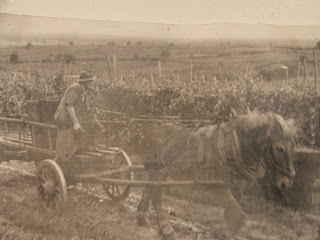
My uncle working in the vineyards
My aunt Maria went to Marseilles, in the Free France, as a nurse, and died of cancer during the war.
Henri didn’t manage the farm very long; he was caught by the SS and brought to the Kommandantur in Colmar, three miles from Eguisheim, in the early days of the war. They had found a letter from his Free Army brother on him.
My Mom, Jeanne, was only 17 at the time; she wasn’t afraid, and was very determined! She walked right up there and pleaded for her brother so earnestly that she got to take him out of the SS' hands.
It didn’t work as well the second time, when they caught him picking up a British propaganda flyer from the road. Henri was sent to the only concentration camp in France, the Natzweiler-Struthof, until the end of the war.
He survived the war and came back long after the armistice. At 6’2’’, he weighted only 50 kg. 

Drawing by Henri Gayot
from the Struthof camp
Since my grandfather couldn’t walk and my uncle was gone, my Mom managed the farm by herself, with the help of Polish prisoners supplied by the Germans. In the last days of the war, she saw the leftovers of the German army: 16 and 17 year old kids, getting drunk before going to the last battles with knives as their only weapons. Fewer and fewer of them returned each time, until there were no more.
This area of France was one of the last places to be liberated in February 1945.
Remember that the allies had landed in Normandy in June 1944.

My Mom was now 23 years old. She met my Dad while the French, Moroccan, and US armies marched through Alsace to Germany in 1945; they got married in October 1946. 

Rue des fossés, Eguisheim