By Christian
It’s during the liberation of Alsace,
in the winter of 1945, that my Dad met my Mom in a little day dancing/coffee/pub
that’s still in business to this day. I don’t believe World War II happened so that my
parents could meet, but really, what were the odds that these two should meet? The Lord works in mysterious ways!
 |
| The place where my parents met |
After he met my Mom, my Dad still had
to go to Germany with the French led Moroccan troops before he could come back
for her, in that beautiful little village of Eguisheim, cradle of Pope St Leon
IX (11th century).
 |
| Pope St. Leon IX's birth place |
My Mom’s whole family lived in the big village farm. It was built in 1684
by the Ginglinger family.
My cousin, Pierre-Henri Ginglinger, still lives there. One of his sons, Matthieu, the twelfth generation of the same vineyard owners, started a two million euro renovation in 2012 for his own family (Click here to see Matthieu on the French TV a few weeks ago.)
 |
| The Family house before renovation |
So where can I start with my Mom’s
side of the family, the Ginglingers?
Their house had been built as part
of one of the two gates of the village. I was told that it used to be a relay, where people would switch their horses, and also an Inn. Mainly, though, it was a
farm with huge barns and cellars. The farms, until after World War II, were
self-sufficient; wine grapes were the main crop, but they also had cows, horses,
pigs, and poultry. So my Great grandfather was a farmer, growing potatoes,
wheat, barley, vegetables, and fruit trees.
 |
| The Family's wine flyer with my cousins Marie-Jo and Pierre-Henri |
He was also the mayor of the village; his best friend was his
assistant. Since the fathers had such a good friendship, their two sons, who were the
same age, became good friends too.
Alsace is a very rich province of
France.
 |
| Arriving in Eguisheim, with the ruins of 3 castles on top of the hill. |
It has been occupied by the Germans on and off many times during the
past 2,000 years. The Prussians also invaded Alsace during the Prussian
war and settled there from 1870 to 1918. It was a terrible time of forced Germanization of the Alsatians, who were French in their heart of hearts.
 |
| Illustration by Hansi |
Now my grandfather, Henri, already
had a reputation; he was very strong, enjoyed fist fighting in local festivals,
and was a tall, handsome, hard working young man.
He was tired of the German occupation
and wanted to leave the village. With his buddy, he decided to play some tricks
on the occupants.
One day, they tied a large French flag to the top of a very tall cypress in the
cemetery, right in the Alsace plain so it could be seen from miles away. Of
course, to make it more fun, they uncoiled barbed wire on their way down the
tree.
The German Feldwebel didn’t have a
great sense of humor. He suspected the two boys, but had no proof, so he just
gave a warning to the Mayor and his assistant. Another day, when the Feldwebel
opened his shutters, he came face to face with a hanging mannequin in German
uniform, a big sausage as his nose and sauerkraut as his hair. This time he
didn’t need any proof and gave my grandfather and his friend a choice:
prison, or five years in the German navy.
This is how this young Alsatian
farmer got to go around the world several times on the huge sailing boats of
the gracious Emperor Kaiser Wilhelm II.
 |
| My grand-father Henri |
He had so many fights aboard that he
remained a simple sailor and extended his stay by several years. During a ship
inspection, Princess Wilhelmina pointed her riding crop at the missing button on
his uniform. To the silent question he answered, “It’s an extra buttonhole,
your Highness.” She laughed and he didn’t go to jail that time.
When he finally came back, he married
his cousin (twice removed) from across the street, Josephine.
 |
| Joséphine and Henri |
He became the new
mayor and never left his village again. They had five children; Henri, Maria, Marguerite, Léon. My Mom, Jeanne,
was the baby.
World War II broke out early in Alsace, and the Germans moved in once again.
My grandfather had a broken ankle and
could hardly walk. When the Panzers rolled in, because he was the mayor, and his
farm was the gate of the village, he stood in the middle of the main street, his World War I rifle in his hands.
The Germans were nice to him and told
him to go back home, that the war was already over. One of my uncles, Léon, who
was the second born boy, fled right away and joined the French Free Army. After the
defeat of Nazi Germany, he decided farming was not his call; he remained in
the military and was sent to Indochina, later renamed Vietnam.
My uncle Henri was the eldest son, very strong and hardworking. He stayed on to
manage the farm after the war broke out.
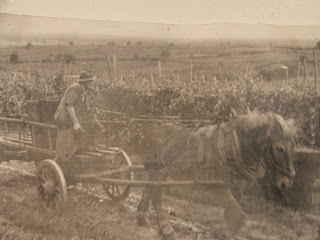 |
| My uncle working in the vineyards |
My aunt Maria went to Marseilles, in the Free France, as a nurse, and
died of cancer during the war.
Henri didn’t manage the farm very long; he was caught by the SS and brought to
the Kommandantur in Colmar, three miles from Eguisheim, in the early days of
the war. They had found a letter from his Free Army brother on him.
My Mom, Jeanne, was only 17 at the
time; she wasn’t afraid, and was very determined! She walked right up there and pleaded
for her brother so earnestly that she got to take him out of the SS' hands.
It didn’t work as well the second
time, when they caught him picking up a British propaganda flyer from the road.
Henri was sent to the only concentration camp in France, the Natzweiler-Struthof, until
the end of the war.
He survived the war and came back
long after the armistice. At 6’2’’, he weighted only 50 kg.
 |
Drawing by Henri Gayot
from the Struthof camp |
Since my grandfather
couldn’t walk and my uncle was gone, my Mom managed the farm by herself, with
the help of Polish prisoners supplied by the Germans. In the last days of the
war, she saw the leftovers of the German army: 16 and 17 year old kids, getting
drunk before going to the last battles with knives as their only weapons. Fewer
and fewer of them returned each time, until there were no more.
This area of France was one of the
last places to be liberated in February 1945.
Remember that the allies had landed in
Normandy in June 1944.
My Mom was now 23 years old. She met
my Dad while the French, Moroccan, and US armies marched through Alsace to
Germany in 1945; they got married in October 1946.
 |
| Rue des fossés, Eguisheim |


