Showing posts with label family. Show all posts

Monday, November 5, 2012

Shaped by the Past - II


Before and during WW II, by Christian

Between 1922 and 1925 Michel Henry traveled to Belgian Congo to establish railroads there. While he was gone, the rest of the family went back to Versailles, France, and stayed with the grand parents.

Michel-Henry in Congo
Staying with the grand-parents in Versailles (my dad in the center)
After the Congo episode, the whole family returned to North Africa, this time in Sfax, Tunisia, where Michel Henry worked for the Public Works from 1925 to 1935. Hélène was giving piano lessons and started another theater company. Things were not going well in the relationship. 
When my Dad turned nine, his parents sent him to a boarding school in Belgium. He took the boat with some friends from Tunisia to Marseilles, France. In Marseilles he took a taxi and visited this huge Mediterranean city by himself, went to the Church of La Bonne Mère, overlooking Marseilles’ harbor and headed to the train station that would bring him a 1,000 km up north. This son of the sun would spend at least one year there and certainly some pretty lonely vacations under the low, cloudy skies of Belgium.   

My father's boarding school in Passy-Froyennes, Belgium
Around 1935, Grandma, also called "la belle Hélène," left the family with a good friend of Grandpa’s to Iran. My grandfather traveled to Iran in 1935 to try to get her back, without success. Still, he stayed there until the end of WWII. We do not know exactly what he did during WWII in Iran; officially he was on call at the French consulate in Tehran. He was a fine tennis player, fluent in English, and was somehow affiliated with the British army Intelligence in Iran. During his time in Iran, Michel Henry was also intimately associated with a woman who was the wife of the consul or the ambassador of Sweden in Tehran at some point. My brothers have pictures of Grandpa with this lady and four children who, we are not sure, but may well be our uncles and aunts too?

Michel-Henry
Michel Henry and Hélène’s four children had been dispersed somehow during this difficult episode. My father was in Tunisia. One of my aunts, Colette, 17, who was very sick, was staying with relatives in Versailles, France.

After the war broke out, Hélène decided to leave Iran and her companion to help my aunt Colette. Since it was forbidden to carry foreign currencies in Iran, plus the fact that she couldn’t cross Turkey, allied to the Nazis, to go to France, she took a bag of precious stones and made her way through India. She sold the stones one by one to pay for her trip and went from monastery to monastery back to France. When Grandma arrived in Versailles, Colette had already left for Morocco to enter the Franciscan Missionary of Mary order. But the boat she was in had been diverted to Algeria. Colette was only seventeen and without money. Somehow, she still managed to arrive safe and sound in Morocco. (She celebrated the 70th anniversary of her vows in 2012. She still lives and works as a nun in Morocco).

Sister Colette
Hélène spent the rest of the war in Versailles and died of cancer in 1945. She never met my Mom.
At the end of the war, Michel Henry left Iran and went back to France, before going on to Morocco. He sent his medal of the resistance back to the General De Gaulle because he didn’t agree with him on some obscures points.
 
The family belongings and furniture that were in storage in Tunisia had been bombed by the French or the Americans, so the family had absolutely nothing left after the war.

Now what about my Dad and the war? After his High School graduation in Tunisia, my Dad, Pierre Ghislain, came back to France, where he enlisted at eighteen in the French army in 1935. He signed up for three years in the military. It wasn’t his best decision, because the war broke out before his time was up. 

My Dad as a soldier
He was sent back to Morocco, where the soldiers were given fake jobs by the French colonial administration, so they would not be considered soldiers for the French government in France, and couldn’t be sent back to the official army under German occupation.  They were getting ready for the right time to come back and liberate France. That’s when my Dad went to war with his Moroccan troops, also called the colonial army. The Moroccans were mostly wild and fierce Arab fighters who enrolled because they liked war. They were fed, clothed, and lured by the promise of rape and looting.
Pierre Ghislain landed first in Sicily in 1944, and then again in France on the Cavalaire beach, the French Riviera. He didn’t get far crossing the beach before he was shot in the arm by the Nazis Stukas. 
Nazi stukas
Luckily, he was rescued and helped by a great French doctor who took good care of him. The good doctor hid my Dad in his own house, risking his and his family’s lives, until the Germans were definitely gone. Later on, he was wounded again while detonating wells used by the Germans as weapons caches. I remember he was still extracting pieces of metal from his face when we were teenagers. For his acts of bravery, he received several medals, and something like a $2 yearly allowance (!). He crossed France with his troops and arrived in Alsace after the end of the Colmar Pocket battle, in February 1945. This battle caused close to 60,000 casualties, 8,000 for the US troops, 15,000 for the French, and over 30,000 for the Germans. It was the last pocket the allies wanted to clean up before they would invade Germany. That’s when he met my Mom. 

My Mom's village in Alsace: Eguisheim
When the Nazis invaded France, my uncle Charles, because he was a seminarian in France with the Franciscans, ended up in Germany doing at least two years of forced labor in a factory with other seminarians; one of them became a Bishop of Morocco. Charles was ordained at the end of the war and sent back to Morocco, where he died in 1997 in a hospital run by Spanish Nuns in Tangiers. He was reading Quo Vadis when death took him. He still had the book wide open and just closed his eyes. 

My uncle Father Charles de Jésus


Wednesday, September 19, 2012

Healing in the Sacrament, Part 2

-->
Before we go further, it is important to give a bit of our backgrounds.

Christian
I was born and raised as a French citizen in a Muslim country, Morocco. The end of the colonial era was surreal in the sixties and seventies. With my two brothers, as teenagers males, we had a lot of freedom; we also knew we had no future in our native country. We would graduate from high school in Morocco, then go to college in France. We were French citizens but didn’t know much about France. We didn’t think we could live there. 
My home town: Meknes, Morocco
We were a Catholic family. I used to help my mom prepare baskets for the elderly as a child. My faith was strong. I wanted to become a religious and my brothers would make fun of me and call me “ the little priest.” We were going to mass every Sunday until I turned 14 and started to skip it until gradually, I stopped altogether.
We lived our lives on a daily basis. We had seen and heard of atrocities, massacres of entire families by Moroccans. Phone lines were tapped; we couldn’t trust the people who were working in our house, even after many years. 
Three brothers and the nannies
I never opened up too much about who I was because who could I trust? I didn’t express my feelings; hey, it was a macho country! I didn’t look for deep conversations since our world could disappear in a moment. I didn’t even speak too loud to avoid eavesdroppers. We lived in a constant state of insecurity. We always had to be careful about what we was said on the phone, in our own house. Anybody could have been arrested just for laughing in a movie theater during the news if the King was on the screen. The police in the theater could think, and even swear, that you were making fun of the King. Of course everything could also be settled for a small amount of money.
We knew we would never take over my Dad’s land surveying company because it could be nationalized at any moment, for no reason. We could also have to pack and leave everything behind at any time without prior notice. It happened to many in Algeria, our neighbor in the East.
The end of such an era was full of mixed feelings. Besides all these insecurities, if you just lived in the moment, life was good and fun; we had a feeling of complete freedom. In this macho country, girls were there to please the men and we loved it. The real guys were those who had as many girls as possible!
Hunting and chasing!

Christine
My hometown, Le Creusot, had nothing to do with sunny Morocco! It was a gloomy workers town in South Burgundy, France. The Schneider family built the town in the 19th century around their big factory. They made cannons, locomotives and armor plates. They had also built churches, hospitals, schools, and owned about everything in town. Everybody was working for them! It wasn’t really a fun town. There wasn’t much to do. People had a strong accent that rolled the r’s, and that was it. Nothing to boast about.
Le Creusot's famous hammer
My childhood was what any outsider would have called “happy.” No major trauma besides my mother’s accident, when I was about 5. She was driving a scooter and ran into a huge moving truck. She landed on the other side of the truck, and was in a coma with a concussion for 3 days. I remember seeing my older sister cry, my Dad awfully worried, but I didn’t really understand what was going on.
Besides this event, it seems like there isn’t much to say. When you look at my childhood pictures, though, you can see that I didn’t smile very often. I had a crabby look most of the time. 
Yes, I'm the one on the right!
Truth be told, my two older brothers weren’t particularly kind and I had no one to defend me. I remember being tied to a tree most of an afternoon, for example. They would also call me names, tell me I was fat and had a big nose... so much for my self-esteem. I would complain to my Mom, but she didn’t want us to pity ourselves, so she would just send me away, saying that they were just “teasing” me. My Dad was completely absorbed in his job and didn’t have any time for us.
I was a very anxious child, probably absorbing my father’s chronic anxiety.
I was also very straightforward and always spoke my mind, which embarrassed my parents more than once!
We were also a practicing Catholic family, going to mass every Sunday. My faith was strong as a child. I was greatly inspired by the stories of the saints and missionaries. When I was six, I wanted to become a nun, a dancing nun actually (I wonder why no one took me seriously?) and I wanted my religious name to be “sister Daffodil,” because they were my favorite flowers (still are!). Then I turned 13 and the Church became liberal in France. That’s when I started to find mass boring.
I brought my insecurity into our relationship, as I had never felt understood. I craved attention, love and protection…  (to be continued)


Friday, September 7, 2012

Instructors Interview: How Did You Meet?

--> Maria and Dan
Maria's Story: In my junior year of college, I spent the Spring semester in Fiesole - just outside of Florence, Italy. There was a small group of students on the program, many like me were studying Art History, and we all enjoyed our time together in this amazing place. We called ourselves the "Villans" - giving a humorous nod to the beautiful Tuscan villa where we studied and most of us lived. 

However, I lived with a host family nearby as did my friend Phil.
Toward the end of our semester, Phil's mom and brother and sister came to visit. Phil invited me and a few others to join them for dinner. 

That evening, we met at the Villa.

The Villa
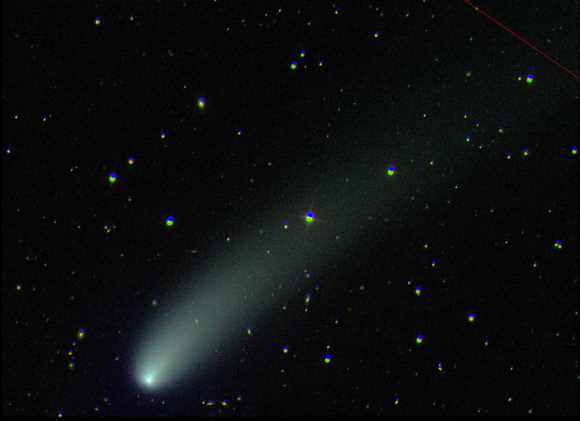
As cliché as it may be, when I first saw Phil's brother Dan, it was love at first sight. We chatted away while walking through Florence and even managed to share our meals with each other at the restaurant. He was only visiting for a few more days, and we kept trying to run into one another. The evening before he left we all went out dancing and then to a cafe where we talked and talked until we missed the last bus and Dan had to walk me to my host family's home. I remember the intensity of Springtime in Italy as we made our way along the stone streets - the heady scent of wisteria blooms, the warmer evening, it was even the height of the Hale-Bopp comet! 

http://www.universetoday.com/wp-content/uploads/2009/07/comet.jp
I found Dan fantastically handsome with his longish curly hair, and his great sense of humor had me laughing till my sides hurt. He was a snowboard instructor in Colorado and seemed to reflect the relaxed freedom of the American West. I also remember thinking he was so intelligent because he remembered a court case that he studied in law school regarding my hometown of Youngstown, Ohio.
But of course his visit was at an end and I still had to finish classes. Dan started making phone calls to his brother and then at the end of the conversation he would ask if I was around. We also kept in touch through some primitive e-mail and of course when I returned from Italy, I made my way out to Colorado to see him again! 


Dan's Story: I moved to Colorado in October of 1995, hoping to teach snowboarding at Beaver Creek. In my second season of teaching, my brother Phil was studying abroad in Italy as a junior in college. Before my dad passed away in 1990, my family had traveled to Italy a few times and it had always been fun. However, I never knew the language. This spring of 1997, my family planned to travel to Fiesole, near Florence, to visit my brother Phil. To prepare for this trip, I studied from a book at the library to learn Italian. My brother teased me that I wouldn't know anything, but I was pleased with my progress.

Fiesole, Italy
I was only in Italy for 6 days. Maria and I can't seem to remember which day we met, but it was special. We were at the Villa, which was beautiful. And my family was staying at the convent very close by. Maria taught me a small part of a piano duet. She was unbelievably beautiful, wonderful, and intelligent. Somehow we managed to share some time together, and even pizza and pasta, which we had to share diagonally across a table of eight or ten people, since we didn't get to sit together, although we really wanted to!
Following my return, I called my brother Phil at the Villa for the first time. Then I asked for Maria! Through God's grace we are here today together with our seven children. And it's still hard to share dinner together across the table of nine people!


2012: Maria and Dan's seven children