Wednesday, November 28, 2012

Shaped by the Past - Part IV

By Christine
My family sure didn’t have as adventurous life as Christian’s!
My father’s grandfather’s name was François, and he was born in 1865 in Gilly sur Loire, from a family of farmers. Francois came to Le Creusot, the nearby booming industrial town, in search of a better life. He was hired at the great forge in 1881, and then transferred to the artillery workshop, producing weapons for the government. He worked there until his death in 1919.

Forge, Le Creusot
My father’s father, Joseph, was born in Le Creusot on November 8th, 1902. His mother, Elisa, was an orphan. She died from liver cancer on October 18th, 1914, when Joseph was only twelve. Her terrible sufferings marked him profoundly for ever. He had only one brother, Francis, who was 10 years older than him. Two other children, born in the middle, had died at an early age. So Joseph grew up with his father Francois. His personality wasn’t the happiest one. He thought that a woman’s job was to stay home and that she shouldn’t even read because it was time stolen from the care of the household. He became a metalworker and supervisor at Le Creusot's Schneider’s factory. 

Joseph at the factory
He wasn’t rich, and I remember that my grandparents didn’t have a bathroom in their second floor apartment. You had to go to the outhouse in the garden. Speaking of gardens, he was a very good gardener, and had lots of vegetables, fruit, and flowers. Dahlias were his specialty.
He never had a car, but when he retired, Joseph got a moppet and he would come visit us on it!
He loved fencing and was an incredibly talented handyman. He even built a radio from scratch. I also remember an incredible hair comb he had made from steel, and a beautiful engraved pie serving knife with a horn handle (I still have it). He also loved fishing and was skilled at painting.
I have at least two good memories of my grandfather. For Christmas, he would offer each of the five of us a 5 francs coin that he had polished and made all shiny. He was also excellent at making black currant liquor, from his own bushes of black currant. The treat was that we were always allowed to taste a small glass, even though it was so strong! I loved how it would run warm down your throat!
He had married Lucie on January 20th, 1925. 

Joseph and Lucie on their wedding day
Lucie had lost her mother too, when she was about 4 years old. Her family was from the north of France, just like General De Gaulle’s mother, who bore the same last name as her. This led me to write to General de Gaulle when I was 9 to tell him that we were from the same family! He answered me and I still have his handwritten note!


Lucie was the baby of eight children. They had moved to  Blanzy, not far from Le Creusot, on a small farm. Her older sisters had very whimsical ways of taking care of her. To calm her when their mother was working in the fields, they would put wine in her bottle! 

Lucie in the center
Very young, she became a housekeeper for a doctor’s family who taught her “good manners.” Then she helped her older sister with her small grocery store. Her sister thought it was time to get her married and arranged her meeting with Joseph. She was a good natured and cheerful person who absolutely loved children. Joseph and Lucie had only two sons, my father, Georges, and Henri. Lucie adored her sons and probably spoiled them a lot, doing everything for them. It was a real heartbreak for her when they got married. When her sisters visited unexpectedly (no phone!), it was always a feast of laughing and fun! She used to quilt heavy blankets to help bring some more money to the household. 

Joseph and Lucie with their two boys
She was the spiritual soul of the family and took her children to church while my grandfather practiced only for great feast days and Bishop’s visits. She would also ride her bicycle everywhere. During the war, she would ride her bike across the line of demarcation to get food to my uncle, Henri, who was at the seminary in free France 40 kilometers away.  She was even searched by the Nazis once. She died at 56. I was not yet 2 when she died, so sadly, I do not remember her.
 

Me in my Grand Mother's arms
Later on my grandfather remarried a woman from Southwestern France, Simone. We all loved her with her singing accent! But Le Creusot was not a cheerful town for her light spirit and she was never happy there.
Even though Joseph had not been a Churchgoer during his youth, he ended his life as a very practicing Catholic and his death in 1971 was a beautiful testimony of faith.

Friday, November 16, 2012

Shaped by the Past, Part III

By Christian
It’s during the liberation of Alsace, in the winter of 1945, that my Dad met my Mom in a little day dancing/coffee/pub that’s still in business to this day. I don’t believe World War II happened so that my parents could meet, but really, what were the odds that these two should meet? The Lord works in mysterious ways!

The place where my parents met
After he met my Mom, my Dad still had to go to Germany with the French led Moroccan troops before he could come back for her, in that beautiful little village of Eguisheim, cradle of Pope St Leon IX (11th century). 

Pope St. Leon IX's birth place
My Mom’s whole family lived in the big village farm. It was built in 1684 by the Ginglinger family. 

My cousin, Pierre-Henri Ginglinger, still lives there. One of his sons, Matthieu, the twelfth generation of the same vineyard owners, started a two million euro renovation in 2012 for his own family (Click here to see Matthieu on the French TV a few weeks ago.)

The Family house before renovation
So where can I start with my Mom’s side of the family, the Ginglingers?
Their house had been built as part of one of the two gates of the village. I was told that it used to be a relay, where people would switch their horses, and also an Inn. Mainly, though, it was a farm with huge barns and cellars. The farms, until after World War II, were self-sufficient; wine grapes were the main crop, but they also had cows, horses, pigs, and poultry. So my Great grandfather was a farmer, growing potatoes, wheat, barley, vegetables, and fruit trees. 

The Family's wine flyer with my cousins Marie-Jo and Pierre-Henri
He was also the mayor of the village; his best friend was his assistant. Since the fathers had such a good friendship, their two sons, who were the same age, became good friends too.

Alsace is a very rich province of France. 

Arriving in Eguisheim, with the ruins of 3 castles on top of the hill.
 It has been occupied by the Germans on and off many times during the past 2,000 years. The Prussians also invaded Alsace during the Prussian war and settled there from 1870 to 1918. It was a terrible time of forced Germanization of the Alsatians, who were French in their heart of hearts. 

Illustration by Hansi
Now my grandfather, Henri, already had a reputation; he was very strong, enjoyed fist fighting in local festivals, and was a tall, handsome, hard working young man.
He was tired of the German occupation and wanted to leave the village. With his buddy, he decided to play some tricks on the occupants.
One day, they tied a large French flag to the top of a very tall cypress in the cemetery, right in the Alsace plain so it could be seen from miles away. Of course, to make it more fun, they uncoiled barbed wire on their way down the tree.

The German Feldwebel didn’t have a great sense of humor. He suspected the two boys, but had no proof, so he just gave a warning to the Mayor and his assistant. Another day, when the Feldwebel opened his shutters, he came face to face with a hanging mannequin in German uniform, a big sausage as his nose and sauerkraut as his hair. This time he didn’t need any proof and gave my grandfather and his friend a choice: prison, or five years in the German navy.
This is how this young Alsatian farmer got to go around the world several times on the huge sailing boats of the gracious Emperor Kaiser Wilhelm II. 

My grand-father Henri
He had so many fights aboard that he remained a simple sailor and extended his stay by several years. During a ship inspection, Princess Wilhelmina pointed her riding crop at the missing button on his uniform. To the silent question he answered, “It’s an extra buttonhole, your Highness.” She laughed and he didn’t go to jail that time.

When he finally came back, he married his cousin (twice removed) from across the street, Josephine. 

Joséphine and Henri
He became the new mayor and never left his village again. They had five children; Henri, Maria, Marguerite, Léon. My Mom, Jeanne, was the baby.

World War II broke out early in Alsace, and the Germans moved in once again.
My grandfather had a broken ankle and could hardly walk. When the Panzers rolled in, because he was the mayor, and his farm was the gate of the village, he stood in the middle of the main street, his World War I rifle in his hands.

The Germans were nice to him and told him to go back home, that the war was already over. One of my uncles, Léon, who was the second born boy, fled right away and joined the French Free Army. After the defeat of Nazi Germany, he decided farming was not his call; he remained in the military and was sent to Indochina, later renamed Vietnam.
 
My uncle Henri was the eldest son, very strong and hardworking. He stayed on to manage the farm after the war broke out. 
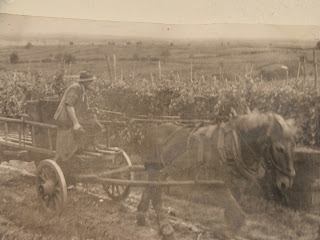
My uncle working in the vineyards
My aunt Maria went to Marseilles, in the Free France, as a nurse, and died of cancer during the war.
Henri didn’t manage the farm very long; he was caught by the SS and brought to the Kommandantur in Colmar, three miles from Eguisheim, in the early days of the war. They had found a letter from his Free Army brother on him.
My Mom, Jeanne, was only 17 at the time; she wasn’t afraid, and was very determined! She walked right up there and pleaded for her brother so earnestly that she got to take him out of the SS' hands.
It didn’t work as well the second time, when they caught him picking up a British propaganda flyer from the road. Henri was sent to the only concentration camp in France, the Natzweiler-Struthof, until the end of the war.
He survived the war and came back long after the armistice. At 6’2’’, he weighted only 50 kg. 

Drawing by Henri Gayot
from the Struthof camp
Since my grandfather couldn’t walk and my uncle was gone, my Mom managed the farm by herself, with the help of Polish prisoners supplied by the Germans. In the last days of the war, she saw the leftovers of the German army: 16 and 17 year old kids, getting drunk before going to the last battles with knives as their only weapons. Fewer and fewer of them returned each time, until there were no more.
This area of France was one of the last places to be liberated in February 1945.
Remember that the allies had landed in Normandy in June 1944.

My Mom was now 23 years old. She met my Dad while the French, Moroccan, and US armies marched through Alsace to Germany in 1945; they got married in October 1946. 

Rue des fossés, Eguisheim


Monday, November 5, 2012

Shaped by the Past - II


Before and during WW II, by Christian

Between 1922 and 1925 Michel Henry traveled to Belgian Congo to establish railroads there. While he was gone, the rest of the family went back to Versailles, France, and stayed with the grand parents.

Michel-Henry in Congo
Staying with the grand-parents in Versailles (my dad in the center)
After the Congo episode, the whole family returned to North Africa, this time in Sfax, Tunisia, where Michel Henry worked for the Public Works from 1925 to 1935. Hélène was giving piano lessons and started another theater company. Things were not going well in the relationship. 
When my Dad turned nine, his parents sent him to a boarding school in Belgium. He took the boat with some friends from Tunisia to Marseilles, France. In Marseilles he took a taxi and visited this huge Mediterranean city by himself, went to the Church of La Bonne Mère, overlooking Marseilles’ harbor and headed to the train station that would bring him a 1,000 km up north. This son of the sun would spend at least one year there and certainly some pretty lonely vacations under the low, cloudy skies of Belgium.   

My father's boarding school in Passy-Froyennes, Belgium
Around 1935, Grandma, also called "la belle Hélène," left the family with a good friend of Grandpa’s to Iran. My grandfather traveled to Iran in 1935 to try to get her back, without success. Still, he stayed there until the end of WWII. We do not know exactly what he did during WWII in Iran; officially he was on call at the French consulate in Tehran. He was a fine tennis player, fluent in English, and was somehow affiliated with the British army Intelligence in Iran. During his time in Iran, Michel Henry was also intimately associated with a woman who was the wife of the consul or the ambassador of Sweden in Tehran at some point. My brothers have pictures of Grandpa with this lady and four children who, we are not sure, but may well be our uncles and aunts too?

Michel-Henry
Michel Henry and Hélène’s four children had been dispersed somehow during this difficult episode. My father was in Tunisia. One of my aunts, Colette, 17, who was very sick, was staying with relatives in Versailles, France.

After the war broke out, Hélène decided to leave Iran and her companion to help my aunt Colette. Since it was forbidden to carry foreign currencies in Iran, plus the fact that she couldn’t cross Turkey, allied to the Nazis, to go to France, she took a bag of precious stones and made her way through India. She sold the stones one by one to pay for her trip and went from monastery to monastery back to France. When Grandma arrived in Versailles, Colette had already left for Morocco to enter the Franciscan Missionary of Mary order. But the boat she was in had been diverted to Algeria. Colette was only seventeen and without money. Somehow, she still managed to arrive safe and sound in Morocco. (She celebrated the 70th anniversary of her vows in 2012. She still lives and works as a nun in Morocco).

Sister Colette
Hélène spent the rest of the war in Versailles and died of cancer in 1945. She never met my Mom.
At the end of the war, Michel Henry left Iran and went back to France, before going on to Morocco. He sent his medal of the resistance back to the General De Gaulle because he didn’t agree with him on some obscures points.
 
The family belongings and furniture that were in storage in Tunisia had been bombed by the French or the Americans, so the family had absolutely nothing left after the war.

Now what about my Dad and the war? After his High School graduation in Tunisia, my Dad, Pierre Ghislain, came back to France, where he enlisted at eighteen in the French army in 1935. He signed up for three years in the military. It wasn’t his best decision, because the war broke out before his time was up. 

My Dad as a soldier
He was sent back to Morocco, where the soldiers were given fake jobs by the French colonial administration, so they would not be considered soldiers for the French government in France, and couldn’t be sent back to the official army under German occupation.  They were getting ready for the right time to come back and liberate France. That’s when my Dad went to war with his Moroccan troops, also called the colonial army. The Moroccans were mostly wild and fierce Arab fighters who enrolled because they liked war. They were fed, clothed, and lured by the promise of rape and looting.
Pierre Ghislain landed first in Sicily in 1944, and then again in France on the Cavalaire beach, the French Riviera. He didn’t get far crossing the beach before he was shot in the arm by the Nazis Stukas. 
Nazi stukas
Luckily, he was rescued and helped by a great French doctor who took good care of him. The good doctor hid my Dad in his own house, risking his and his family’s lives, until the Germans were definitely gone. Later on, he was wounded again while detonating wells used by the Germans as weapons caches. I remember he was still extracting pieces of metal from his face when we were teenagers. For his acts of bravery, he received several medals, and something like a $2 yearly allowance (!). He crossed France with his troops and arrived in Alsace after the end of the Colmar Pocket battle, in February 1945. This battle caused close to 60,000 casualties, 8,000 for the US troops, 15,000 for the French, and over 30,000 for the Germans. It was the last pocket the allies wanted to clean up before they would invade Germany. That’s when he met my Mom. 

My Mom's village in Alsace: Eguisheim
When the Nazis invaded France, my uncle Charles, because he was a seminarian in France with the Franciscans, ended up in Germany doing at least two years of forced labor in a factory with other seminarians; one of them became a Bishop of Morocco. Charles was ordained at the end of the war and sent back to Morocco, where he died in 1997 in a hospital run by Spanish Nuns in Tangiers. He was reading Quo Vadis when death took him. He still had the book wide open and just closed his eyes. 

My uncle Father Charles de Jésus


Friday, November 2, 2012

What's Beyond the Veil?

By Christian
A tale of All Souls

My whole family is French, but as you should know by now we lived in Morocco. My Dad was born there, when it was still a French colony.
My Mom, Jeanne, was from Alsace. My father had met her at the end of the war, while liberating France. She was very outgoing and as such had many friends. 

My mother, Jeanne
One of her best friend’s name was Germaine.
Germaine was married; she had three children and was about ten years younger than my Mom. Our two families would often go water skiing, and we spent a great deal of time together.

At the lake
One day, my Mom and Germaine made a promise to each other: that the first one to go to Heaven would come and welcome the other one for the great passage.
By the time I came into the world, it was the end of the colonial era.
In 1970, the Moroccan government nationalized Germaine’s family farm. The whole family had to leave for France to begin re-building their lives from scratch.
Eventually, our family moved into the house they’d left in Morocco. 

Our house
Our families kept vaguely in touch.
My Mom died from cancer three years later.
I was living in France by that time, and about ten years later, I learned that Germaine too had cancer, and wasn’t doing too well.
Sadly we lived far away and I couldn’t visit her.
One day Germaine’s son, Daniel, called me; it wasn’t good news.
He told me that his mother had passed just a few minutes before.
He said that she had entered into a coma some days earlier and couldn’t communicate for a while. But he wanted to let me know that just before entering into her new life she sat up on her bed and opened her eyes. She was wide-awake and looking straight in front of her. With a broad grin she cried: “Jeanne, Jeanne!” and passed.
We don’t know what’s behind the veil, but Daniel was certain that my Mom had come to welcome his Mother and that was real.

Wednesday, October 31, 2012

Grey is November

By Mattie
Grey is November,
cold as cold.
Stormy November,
wind and rain.
No snow. 
No ice.
No glittering sun.
Grey is November,
except
by the bright fire
with a story, 
a cushion for the cat,
the dark shut outside
and
the light in the flames
where mysteries lie
and
we dream.

Elsa Beskow, Around the Year

To me that's exactly what November brings to mind! Just to say the name, I can only see gray skies and a nice warm stove and Joshua reading in front of it:
And yes, it gets this nice with the stove that short sleeves are the only option :)
But that's just the cozy side of things :) What about the spiritual aspect of it?
Well to me it is grey as well! Funny isn't it!? Maybe it is because this month is dedicated to the Souls in Purgatory? Or maybe because it's the last stretch before Advent (my favorite Liturgical Time)? I am not sure, but to me November = grey.

So shall we look into this grey month and find some glittering sun?

Well, first of all there is the radiant sun of the Feast of All Saints on November 1st!
Wow, what a fantastic feast! To be able to celebrate ALL the Saints in one day! As a family we first go to Mass, since it is a Holy Day of obligation, and then we gather all of our saints icons, holy cards, etc... and make a beautiful altar displaying them all with candles and foliage. And then the best part: stories! (I told you this poem was EXACTLY what November means to me :)) We gather all of our saints books and start reading. And that's how we spend our day: no school, just saints! And of course cake and candies!


Next is All Souls Day, on November 2nd. Another beautiful day for us to start with Mass to pray for the souls of our deceased loved ones.
Here are the guidelines to obtain a Plenary Indulgence on that day as well (or during the that week).
At home, I have made a poster with the pictures of all our deceased loved ones, and I add funeral cards every year. We leave this poster displayed for the month and pray for each soul everyday. And that is where the story part comes in: talking to the children about each departed soul! What a memory maker and how much the children love to learn about their deceased family members and remember dear friends.

The Passage of Souls by Louis Janmot (18140-1892)
On the 3rd, it is Saint Martin de Porres! A ray of sunshine straight from Peru. Maybe Rudy and Carmen will be able to share a little bit of the Peruvian traditions that accompany his feast day... Stay tuned!
Also on the 3rd is a favorite patron saint in our house: St. Hubert! Patron saint of hunters! He gets a cake with a Playmobil elk and a hunter (usually a knight)!

Cool hunting shirts can be found here
November 11th: Veterans Day and St. Martin de Tours' feast day. Perfect day to donate old coats to a homeless shelter! He is the Patron Saint of tailors ... and drunkards!
Horseshoe Cookies for Martinmas

November 13th: St. Frances Xavier Cabrini. For us Denverites, nothing easier than to go visit her shrine in Golden!
Italian Fare for the Feast of Mother Cabrini.

November 16th: St. Margaret of Scotland
A Scottish Feast to Celebrate Saint Margaret and Saint Andrew (November 30th)

November 22nd: Saint Cecilia, patroness of musicians and the Academy of Music in Rome.
Just turn up the music! This year, her feast day falls on Thanksgiving day: a good opportunity for double celebration!

November 25th: Christ the King
A big day in our family as it is both Christian and Christine's feast day, or name day!
We do celebrate everyone's name days throughout the year. Not as big a deal as birthdays but still we have cake and the person's whose feast day it is receives a small spiritual/religious present. We started with a book or movie about their patron saints (including middle name patron saints) and are slowly moving towards favorite saints, devotions, etc... Books, Icons, etc... make wonderful Name Day gifts.

On November 27th, we celebrate the Miraculous Medal of the Blessed Virgin Mary. This is a special day for Christine and Christian because it is the day they met! This year will mark for them the 38th anniversary of their meeting.

And then off into Advent! Yeah!
So give thanks, find the glittering sun during this grey month, and praise the Lord!

Click here to read on the lives of all the saints for the month of November. Make sure to bookmark this site!


Saturday, October 27, 2012

Shaped by the Past, part I

By Christian

Our family trunk
Not long ago, one evening after dinner, I was showing our friends Mike and Marylyn a beautiful wooden trunk from Alsace, dated 1776, that I'd inherited from my Mom. It had been in the family since… 1776! I also showed them some antique silver Berber jewelry from Morocco that I had just brought back to the USA. Then Mike asked me how my ancestors had gotten to Morocco in the first place. 

I’ll jump from 1210, where we find the first trace of a Petrus Meert in Belgium, to the 19th century. To make a long story short, our family, on my father’s side, originated from Belgium. After the Napoleonic wars, they settled in France. At least three of our ancestors fought with Napoleon. Their names are engraved in the Arch of Triumph in Paris, on the Champs Elysées: Général Jean François Aimé Dejean, and his son Général Pierre François Marie Auguste Dejean (whose son became the French Minister of War in 1870, when France lost Alsace-Lorraine to the Germans, first link to my Mom’s side of the family), and Baron Général de Chamorin killed at Campo Mayor, Portugal in 1811.

Arc de Triomphe, Paris
My great, great grandfather was already French and had opened the very famous Chocolaterie Meert in Lille It's still in business today, and still very famous, though sadly not in the family anymore, but still bearing the name. 

Emblem of the Meert's chocolaterie
The General

My great grandfather was a general in the French army, Albert Ambroise Antoine Meert. He came to Tangiers, Morocco, for his son’s wedding to my grandmother on February 19, 1917. The general, his wife, and their daughter got stuck in Morocco after the wedding because of the German submarines patrolling the Gibraltar Chanel. They were still there for the birth of my Dad in Tangiers, Dec. 20, 1917.

At the time, most European countries were fighting to annex as many colonies as possible. France fought against the Turks in Algeria. The Turks had occupied most of the Mediterranean basin for centuries, including Palestine and Israel. France's main goal was to stop piracy in the Mediterranean, to free Christian slaves/prisoners, and all Christians who had been forcibly converted to Islam, the Janissaries. Then the French moved on to Tunisia, in the East, to Morocco, in the west, and to the Sub-Saharan countries of Africa to the South.

Hélène
When I was a child, we kept the general’s uniforms in a large steel case along with his swords and hats. He had been governor of Dunkirk and St Malo, and had an impressive series of medals; the most impressive one was a huge star of gold and vermeil that he had received from the Tsar in person in 1901. He had been a prisoner in Germany from 1870 to 1871 and had served in Algeria and other wars and colonial conquests.

By now, you know that my grandfather, Michel Henry Meert had married in Tangiers. My Grandmother, Hélène, whom I never knew because she died in 1945, was a French lady whose family originated from Valparaiso, Chile. They were in the import/export business. She was an artist, and moved to Tangiers with her family because of health problems. In Tangiers, she founded a live theater company. One day my grandfather happened to be an understudy for a sick actor, and the rest, as they say, is history. 
Her father was an inventor, and Freemason. 
He had invented the radial tire, but lost his invention to Michelin after a painful trial. 
He had also invented a transportation network of hot air balloons for Paris, a sort of aerial transport system where people could access and leave the balloons from rooftops. Sadly, it never took off.
Michel Henry
 
Michel Henry arrived in Morocco while serving in the military in 1912. Poor timing that made him stay there during and after WWI. 
The French Maréchal Lyautey was in charge of Morocco during WWI and kept all military personnel there to continue the development of the infrastructure: roads, railroads, electrification, telephone, and more. My grandfather worked for a Franco-Spanish railroad company that was building the railroad from Tangiers to Fez. As proof of originality, they named it the Tangiers-Fez Company. 
He was in charge of surveying construction and buying land from the local tribes.

From what I've been told, they had a pretty good life there, and lived on a grand scale. My grandparents had four children, starting with my dad, Pierre Ghislain, who was born in Tangiers, in 1917. I know they lived in Meknes, Morocco, for a while, to follow the railroad construction, Meknès being only 60 km from Fez. (More exciting stories to come...)